
At the Fo’c’sle Tavern in Chester, October 2010. L-R: Malcolm, Charles, Mike, Dorcas, Heather, Steve, June
At the Fo’c’sle Tavern in Chester, October 2010. L-R: Malcolm, Charles, Mike, Dorcas, Heather, Steve, June
One Christmas we met in Montreal, where Heather and Pam were living. 


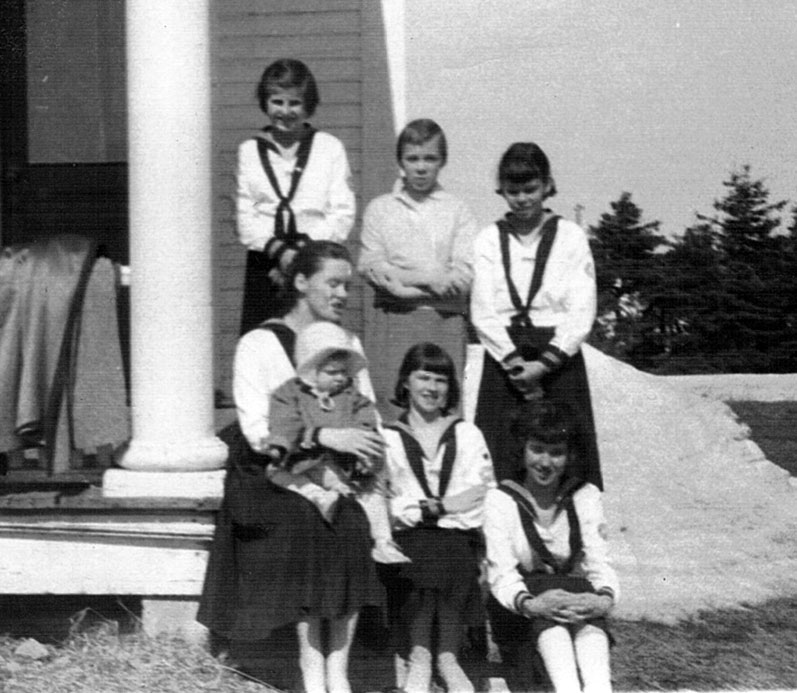
Leading a group of CGIT (Canadian Girls in Training, the United Church’s version of Girl Guides) with baby Heather on her knee, New Mills, NB, c. 1959

Outside the church on a Sunday morning, about 1967. Pam is in the background.
Being a minister’s wife was not easy.
It was life in a fishbowl, with everyone watching, and you couldn’t really be friends with people in the congregation as they would put the minister’s wife on a bit of a pedestal. Also, there were politics.
You’re playing a role, and there will be gossip, whether you do it well or not.
And your children had better behave in church.
What was worse, especially for her, was she couldn’t make her own decisions about paint and wallpaper in the house because the Manse Committee took care of that.


What I remember about my mother’s 1960s hairstyle was that it took a lot of work. There was the backcombing, by which you combed your hair straight up and then combed it back towards your scalp again, creating a tangled mass beneath the layer that was smoothed over it to give it the bouffant look. There were the curlers to give it body, as her hair was naturally very straight. She’d sleep in her curlers or use a sit-under hairdryer – that was a big purchase. It was also a big deal when she got a curling iron. And the hairspray! I don’t know if she matched the scent of her hairspray to her Chanel No. 5 cologne with the same attention that she paid to matching the colours of her clothes. I’ve always gone with simple easy hairstyles in protest. But she was a beautiful woman, and this is what beautiful women did. She obviously considered the result worthy of a rare formal portrait.

Somewhere in the mid 1960s
How do you choose a obituary photo for someone who is 80 and had been ill for quite some time? Mom often asked me to take pictures of her so that there would be good options. But when the time comes, do you choose a recent one, or one that goes back a few years? In the end we went with a photo from before she was sick, and was active and involved in things like the Garden Club and Tai Chi, so that people who knew her then would recognize her. And the candidates were (click any photo for gallery with captions):





The Charlottetown Guardian was started before 1900 by a Scotsman named Mr. Burnett, and it was now run by his four sons. I had read the newspaper growing up so I was thrilled when my application for employment was accepted.
My job was in the circulation department doing typing and filing, plus, since the general office was near the front door, I also worked at the counter, where people could buy a copy of the paper or put in a classified ad.
About a dozen people worked in the general office, plus the nearby offices of three of the sons, making for much traffic. Lots of people to get to know. Two girls close to my age — late teens or early twenty’s — plus two elderly women, who wore out-of-date clothing, and were treated with respect. I learned that they were still working because they could not afford to quit! There would be no pension from the Guardian when they did; this was 1950, doubtful if government pensions were available, or they would be very small. There was a man with some mental disability who worked there too. He was totally loyal and so trusted by the bosses that he carried the cash deposit to the bank at times, and did other errands.
I worked in the circulation department with two men, father and son, whose nicknames were Bomber and Babs. Bomber had been in the armed forces with one of the bosses, so they got away with lots of breaks, to talk about hockey or whatever was happening. This made it necessary for me to diplomatically break up these sessions when work really called for their presence.
A great thing about working in a small newspaper was that we were always in touch with what was currently happening in the city or the world.
The second floor included the newsroom where news editor and reporters had their space. I was interested in the huge dictionary which had its own stand. One of the reporters became a long-term friend. She was from Winnipeg, had worked in the Arctic, and was a Baha’i, and introduced me to a wider world view. Some of her reporting assignments such as town meetings seemed to be so boring that I realized I would prefer to be a feature writer on selected topics. But she had the steady job!
The Linotype machines, keyboard operated, were also on the second floor. There were five or six men and one woman working these. Everything in the paper had to be written on these machines, in lines, using hot metal which quickly become solid. This was exacting work. We had proof-readers who found any flaw. It was also dangerous as there was some lead in the hot mixture. These matrices were fitted in such a way that they would fit on the huge presses which printed the newspaper.
The press that printed the daily paper was run at night, but there were special editions which had to be printed in the daytime, and we office people were able to see the process. Huge rolls of newsprint were lifted in place, barrels of ink were required. There were many moving parts that had to be kept oiled. It was dangerous but exciting for the men who ran the press.
We had our own cartoonist at the Guardian, an idealistic young man from one of the north-eastern States. When I had some free time I would climb the wooden stairs to his hide-away office on the top floor, and if he was free we talked of many things. He could have some cartoons done in advance, such as something for Christmas, but had to be always ready for a cartoon suitable for a breaking story.
One event we all enjoyed was the visit of Princess Elizabeth and Prince Philip in 1951. The cavalcade was to pass just in front of our building so all the staff were given flags and took places on the street corner. I felt like a kid again, waving a flag.
I had been at the Guardian for three years and the urge to see other places was getting stronger. The day came to leave. All the goodbyes, etc., had been said, but as I reached the door someone came forth with a beautiful suitcase, a gift from the staff. More goodbyes and thanks. And I walked away with my new suitcase and headed for new horizons.
by June Maginley, 2012
My brother was three years older than me. I had twin sisters who were two years younger. My mother was a small, gentle woman. She had read widely, travelled, lived in New York, and written poetry. My father received brutal treatment as a child and had lived in a war-torn land before coming to Canada. He had worked for farmers in the West.
We lived on a farm which had a magical feature that charmed and consoled us—a brook which entered our property back in our woods, and gave us fishing holes, swimming and bathing spots, and an ever running spring of pure sweet water. There were flood plains, reedy in summer, but in winter thaws they froze over and gave us sheets of ice where we learned to skate and play hockey.
This was during the Great Depression, when life was very hard for most people but especially for a couple on a new farm. They had lost their first baby, then had four children, with miscarriages in between causing grief and stresses for both. Conflict in my world. I was becoming aware of shouting and arguing. I saw my father strike and kick at my mother. She was my source of love and security. As my brother got older he became the object of my father’s anger as well. He was my protector and friend. A winter day after a storm, our father was going to drive us to school. Farmers took turns breaking the winter road. My brother was late and when he got into the sleigh, my father started kicking him. I screamed at him “Stop that”. “You are not fit to be a father”. He stopped. Later I wondered where did ever get the gall!!!
I learned to always be on my guard around my father. To talk about intellectual things. To lie whenever my brother might be involved. I learned to never innocently flirt. I saw my brother go through a phase of not talking for three weeks as he sat and thought. I know now that during that time he was absorbing the “I’m not okay” image of himself but also accepting that he had to get through this place until he was old enough.
Another War came, D.D.T. for farmers, better crops, more money, paid off mortgage. Life goes on. I left home to study and work. My brother had educated himself via correspondence courses in radio and TV repair. He left home to work. He married a girl who was a fiddler, and their lives were involved in making country music. They moved to Ontario. I married and had children. Occasional visits at different times. The obligatory Christmas cards exchanged with names but no news.
One day my sister phoned me from Ontario to say our brother was in hospital in Oshawa. For me arrangements needed for air flight, and for my family. For my sister, to find someone to drive us to Oshawa Hospital. My brother had complications of different problems, but the most obvious was Psoriasis, visible over his head, face and hands. I get a chair by his bedside and speak of how sorry I am for him. His wife is sitting there also. Our sister also wants to talk with him. it is impossible to establish any meaningful connection with him. After some time his wife says that the doctors and nurses have been asking: “what did someone do to him that would cause such a condition?” I knew the roots of many health problems are due to trauma in childhood.
I knew immediately what I should do. I had seen what happened in our family. There was a brief window of opportunity. I could see white coated doctors and nurses in the corridor. But there were two strong women I had to face down. My alpha-female sister and my ego-driven sister-in-law.
I chose the coward’s way–my sister was concerned about our driver getting annoyed. I accepted that for reason to go. I said goodbye to my brother, and left the room and left the hospital.
June Maginley, 2012
The little house at the Crossroads was the home of my great-grandfather, Alexander McKenzie, who was a boot and shoe maker, and employed four men; which was a large business for a country area in P.E.I. The house was on a two acre lot, which allowed for pasturing a horse and a cow, as well as the house itself. No doubt there would be hens as well. There was a line of tall, slender Lombardy Poplars next to the road with a green walk way between them and the house, wide enough for some shrubs and wheelbarrows and children. Another row of the Poplars was at the side next to the field. There were two barns, the small barn and the big barn. The small barn was for the horse and cow and hens, and probably a space for storing the riding wagon and sleigh as well.
The big barn was the shoe factory where my great grandfather and his staff worked. I remember being in the big barn, seeing bits of leather and shoe lasts, and benches where they worked. The house had been abandoned for a few years when I started walking to school and saw it through its stages of aging. We children would take a walk in sometimes and look in through the windows, small in keeping with the small house, with panes broken, and the front door swinging open. The kitchen area went across the narrow end with the door, in the middle was a parlour sort of area, and doors to two small bedrooms on the ground floor. A narrow stairway went upstairs but I don’t remember going up there. There was wallpaper on some of the walls. My great-grandfather died about 1900, and my grandmother moved back in with her mother. My grandfather worked away in New Brunswick lumber industry, and would be home at certain times of the year. My mother was born in that little house, along with four other children. My great-grandmother was referred to by children and, I supposed others, as Grandma McKenzie. She was a very strict Presbyterian. Playing cards were the Devil’s Book. On Sunday reading anything but the Bible or Sunday School papers was not allowed. I expect some of the kids broke this rule whenever possible! Only hymns could be read on Sunday. Grandma McKenzie had the great misfortune to have had her only son leave home and never contact her again. Probably had a quarrel with his father, which was a familiar pattern in those generations. When the children wanted to irritate the grandmother they would sing on Sunday, “Oh, where is my wandering boy tonight”, which caused her to weep, and their mother to get after them.
Being a house near a crossroads meant that there was much socializing, since people would walk to the store or post office, and would drop in to the little house for a “cup of tea” and give the news. The nearby church and school also fostered visiting friends. Before she was married my grandmother had quite a career as a dressmaker or seamstress. She ordered patterns and items like buttons from New York, which was the fashion capital of eastern North America. She probably continued some of this sewing when possible with four children. After Grandma McKenzie died, about 1916, my grandparents bought a larger property, a proper farm, about five miles away. I inherited from knowing this house a fondness for neat houses, Lombardy poplars, and houses beside the road. Sewing, keeping in touch with my children, and clothes that I like, are values that I’ve inherited from the two or three maternal influences in my life.
June Maginley, 2012